Loading content...
DC Metro Gallery Place-Chinatown Station: 3 Lines, Exits
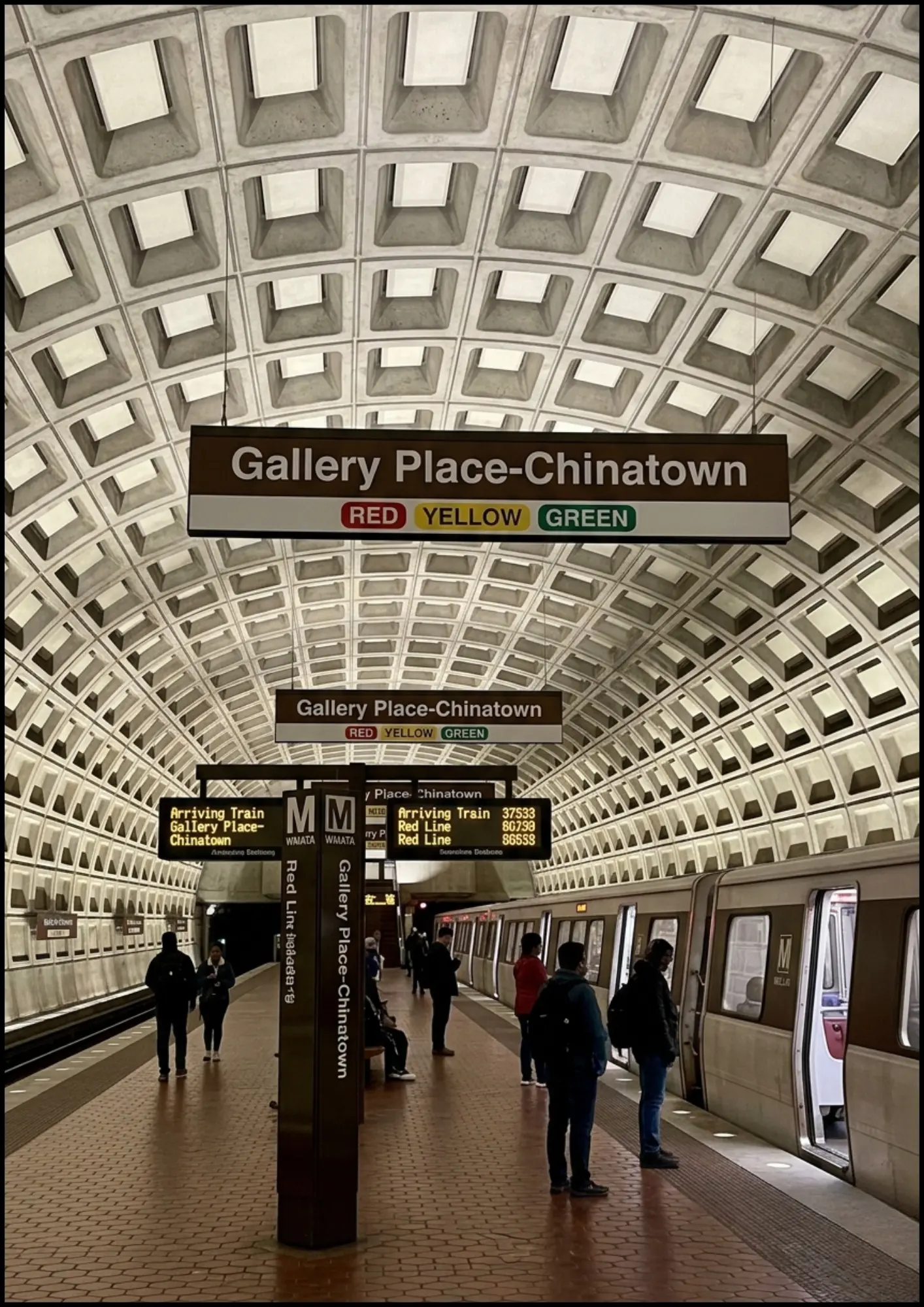
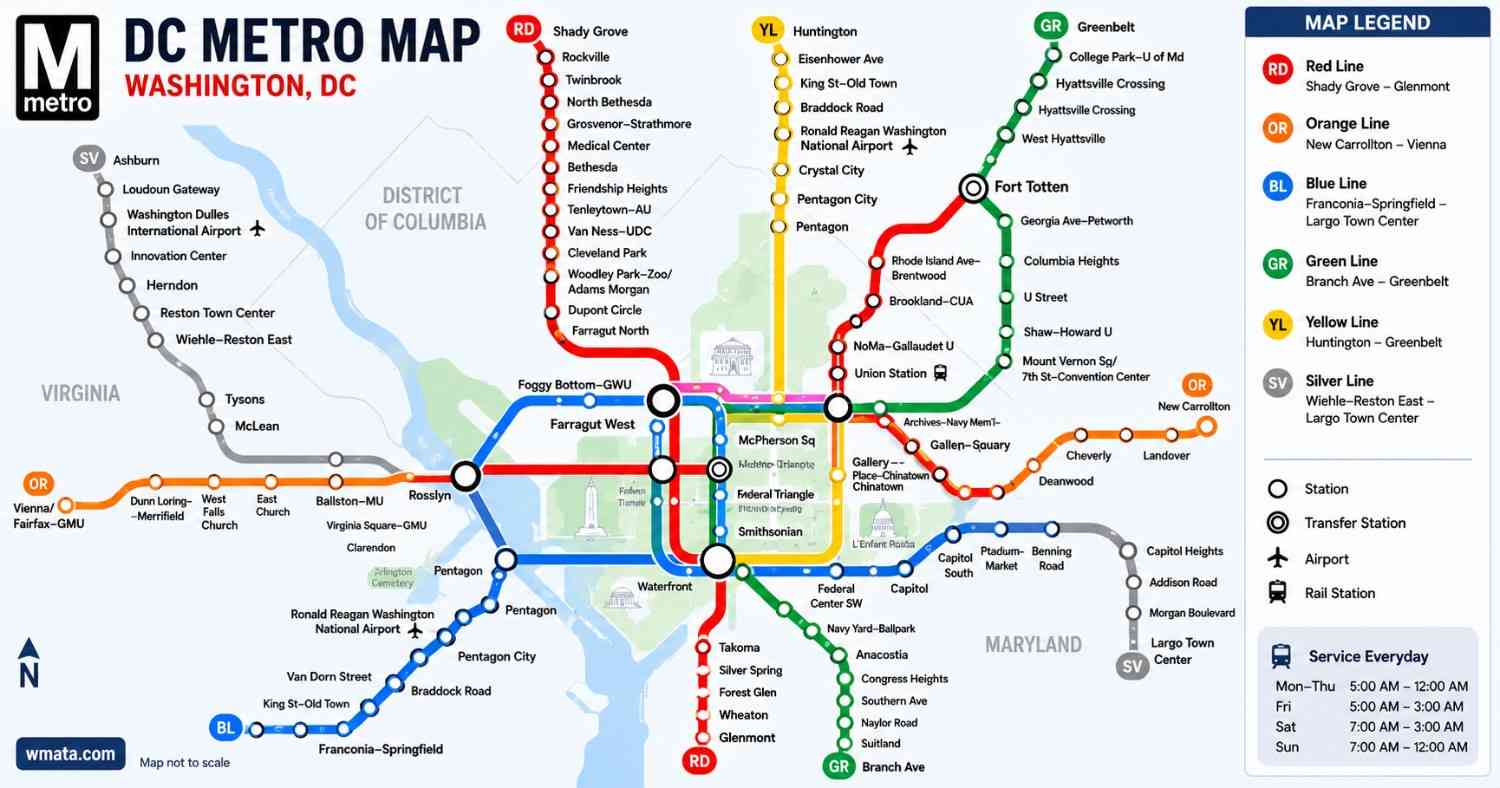
DC Metro Gallery Place-Chinatown Station has three DC Metro lines, namely Red, Greenthe the , the the n and Yellow. It is situated in Washington DC, at 7 th Street and F Street NW, which is directly underneath Capital One Arenathe the . The station has three exits to the street and is one of the four key transfer points in the whole Metrorail system. In 2011, the station was officially renamed to Gallery Place, but with Chinatown as a subtitle, although most customers continue to refer to it using the entire hyphenated name.
Gallery Place-Chinatown Station Overview
One of the busiest stations in the Metrorail system is Gallery Place-Chinatown, which is a mixture of tourist (Smithsonian museums, Capitol One Arena events), entertainment (Capital One Arena events), and daily commuters. It was opened in December 1976 as part of the initial expansion of the Metro and was renamed to incorporate Chinatown in 1986 to reflect the neighboring neighborhood above it, though the Chinatown in DC has since considerably declined.
The station consists of two levels and is in a cross format: Red Line upper (side platforms), Green and Yellow Lines lower ( center island platform ).
Which Metro Lines Stop at Gallery Place-Chinatown?
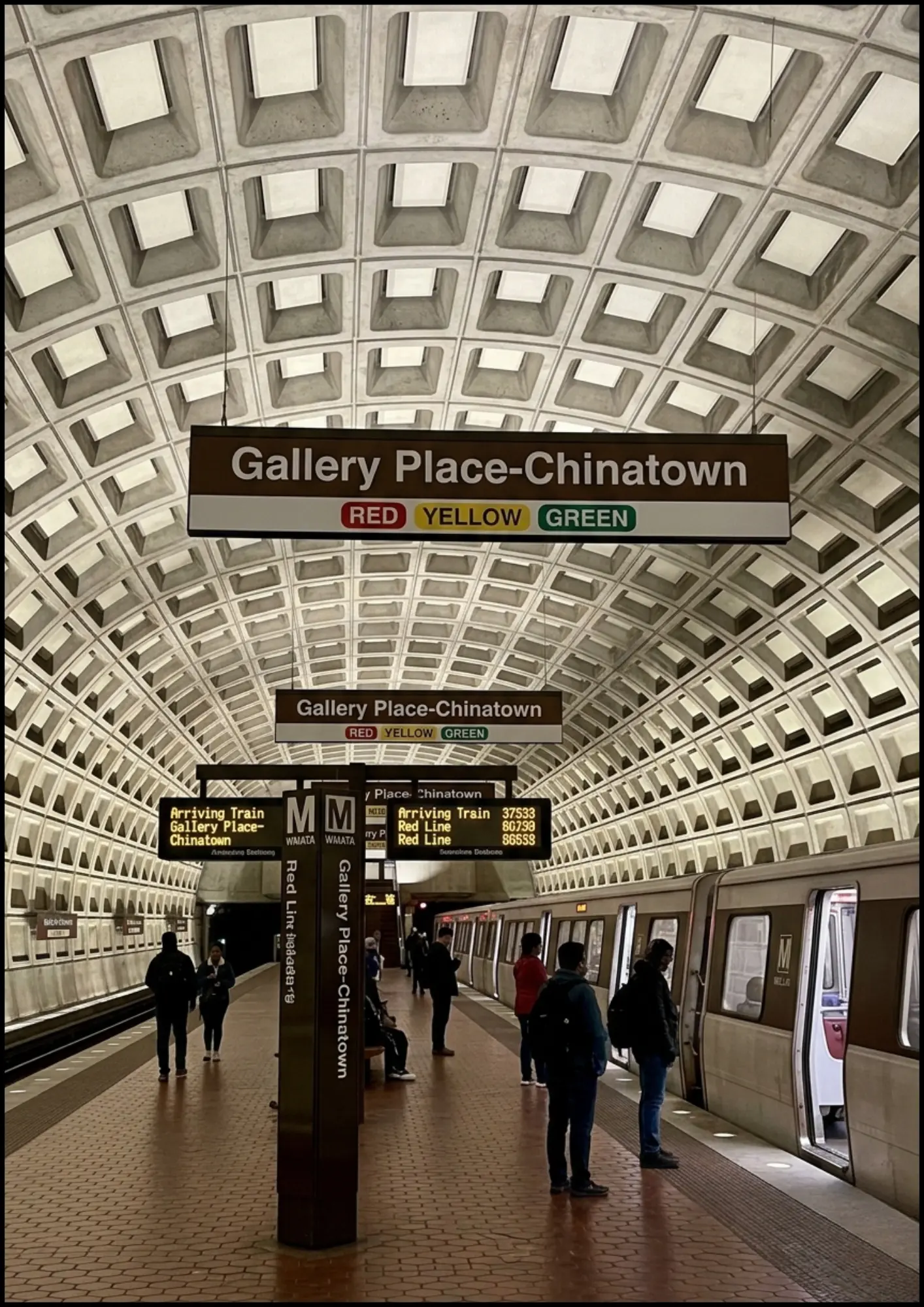
- Red Line — Shady Grove ↔ Glenmont (upper platform)
- Green Line — Branch Avenue ↔ Greenbelt (lower platform)
- Yellow Line — Huntington ↔ Greenbelt (lower platform)
Gallery Place Station Exits and Street Access
Gallery Place has three entrance/exit points:
| Entrance | Location | Best For |
| Entrance A | 7th St & F St NW (southeast side) | Capital One Arena main entrance; Penn Quarter dining |
| Entrance B | 7th St & H St NW (north side) | Chinatown Friendship Archway; H Street restaurants |
| Entrance C | 9th St & G St NW (west side) | National Portrait Gallery (0.1 mi); FBI Building |
The station's only street elevator is located at Entrance A (north side of F Street, east side of 7th Street).
Transferring Between Lines at Gallery Place
Gallery Place-Chinatown is a two-level transfer station. The Red Line platforms are on the uupstairsdownstairsthe, the Green/ Yellow platfoare downstairsairs.
- Red to Green/Yellow: Exit the Red Line platform to the Green/ Yellow platform. The transfer is free and in the paid zone.
- Green/Yellow: Climb escapades/stairs to upper level.
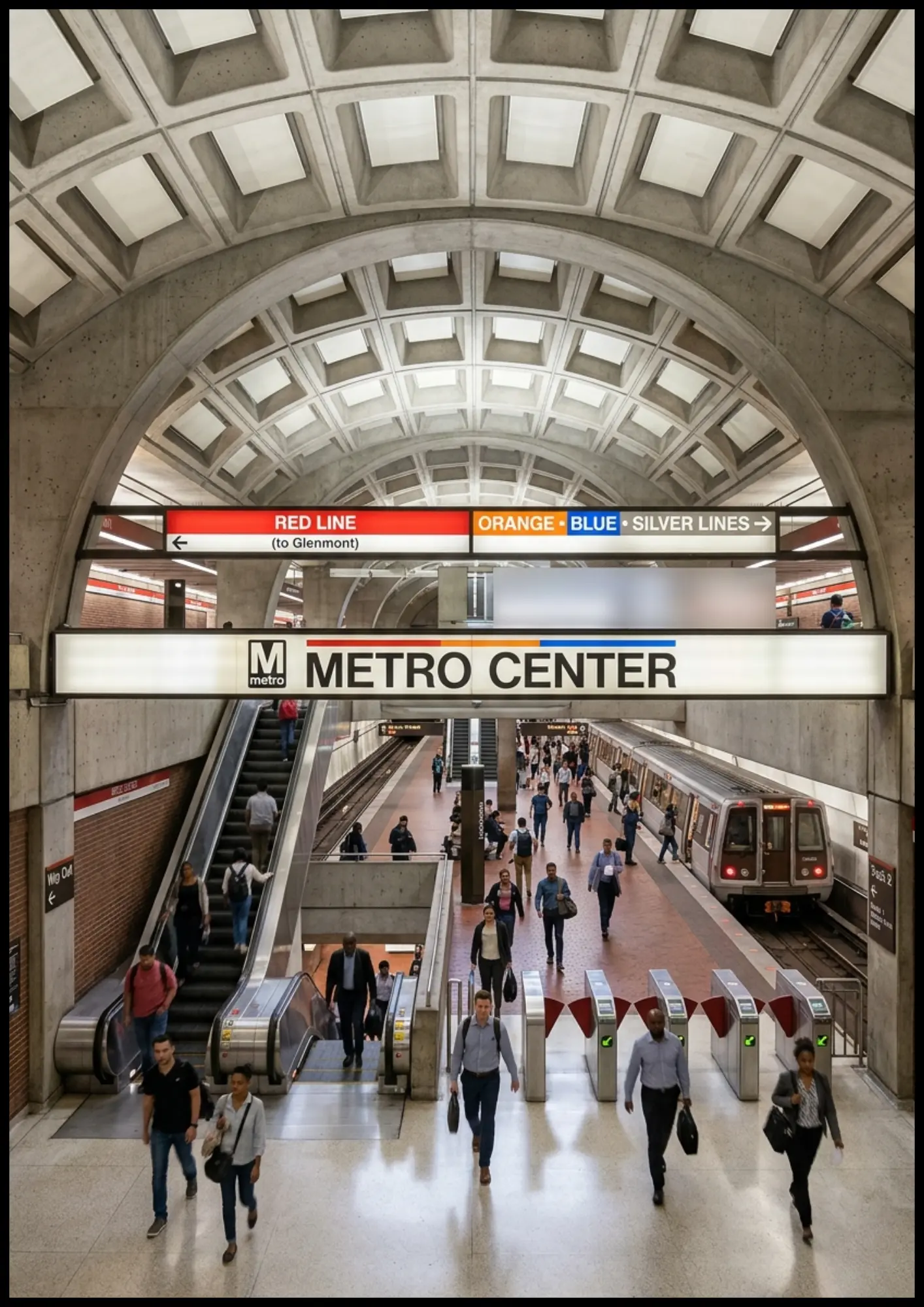
Noteworthy contrast to Metro Center. There is a greater eastward offset of the Green/Yellow platforms at Gallery Place,,. The as compared to Metro Center, the level-to-level transfer is a little longer than at Metro Center. It is advisable to give yourself some time (2-3 minutes) in case it is a timed connection.
DC Metro Gallery Place Station Hours
| Day | Opening | Closing |
| Monday – Thursday | 5:00 AM | 12:00 AM |
| Friday | 5:00 AM | 2:00 AM |
| Saturday | 6:00 AM | 2:00 AM |
| Sunday | 6:00 AM | 12:00 AM |
Things to Do Near Gallery Place-Chinatown
Capital One Arena (Wizards & Capitals) — Directly Above
The Capital One Arena is right on top of Gallery Place station, so this is the nearest Metro station to the types andtypes andWashington Capitals (NHL), Washington Wizards (NBA), and large concerts. The F Street entrance to the arena is less than 100 feet away from Entrance A.
Game-Day Rider Tips:
Allow a minimum of time to arrive at least 30 minutes before if tip-off/puck drop - trains fill rapidly in the last 15 minutes before games.
Post-game: Trains are standing-room-only about 30-45 minutes after events. Wait 20 minutes in a neighbouring restaurant or bar after the first rush of the crowd has cleared, should you have time.
Gallery Place and Metro Center are within the same distance; in case Gallery Place platforms appear unsafe or crowded, a one-block walk towards the West would be to Metro Center.
Metro Center is a little less popular after the event and offers four lines.
Smithsonian American Art Museum and National Portrait Gallery (0.1 miles -Entrance C)
Two of the buildings that are the same, one block apart, house the dual-museum complex of the Smithsonian American Art Museum and National Portrait Gallery, sharing the historic Patent Office Building. The two museums are both free and open on a daily basis. The neoclassical structure is an iconic one on its own.
DC: Chinatown: History and What Remains.
Chinatown DC, around the crossroads of 7th and H Streets NW, comprises some of the last Chinatowns anywhere in a large American city. It was a thriving immigrant community at its zenith in the early years of the 20 th century. Now, there are a few Chinese-owned businesses. The most identifiable symbol of the neighborhood is the Friendship Archway, a red and gold ceremonial archway built in 1986 across H Street on 7th. Although the Chinese community has become small, the neighborhood is still referred to as Chinatown and is a busy food and entertainment area.
Penn Quarter Restaurants and Nightlife.
The immediate area of Gallery Place station, known as Penn Quarter,r is one of the best dining annightlifefe streets in DC. The 7 th, 8 t,h and 9 th Streets NW are lined up by dozens of restaurants of various typesand nightlifetypes, es including casual and upscale. There are plenty of pre- and post-game meals.
Accessibility at Gallery Place-Chinatown
Gallery Place is accessible by ADA and has one elevator in Entrance A (functional elevator on the street level). Both levels have tactile platform edge warnings. Since 2004, the station has been a pilot of new Metro accessibility and wayfinding signage.
FAQ: Gallery Place-Chinatown Station
Q: What is the stop of Gallery Place-Chinatown?
A: Gallery Place-Chinatown is served by three DC Metro lines: Red, Green, and Yellow.
Q: Can you tell me where Gallery Place Metro is?
A: Gallery Place-Chinatown is within the Capital One Arena, 7 th Street and F Street NW in downtown Washington, DC.
Q: What is the best Metro station to go to the Capital One Arena?
A: Yes. The nearest Metro station to the Capital One arena would be Gallery Place-Chinatown, with the main entrance to the arena being roughly 100 feet off of the 7 th and F Street exit of the station.
Q: What is the difference between Gallery Place and Metro Center?
A: Gallery Place has Red, Green, and Yellow lines; Metro Center has Red, Blue, Orange, and Silver lines. They are neighboring stations (separated by a stop on the Red Line,) and both are within walking distance of Capital One Arena.
Q: How come it is referred to as Chinatown when there is no Chinatown?
A: Once a flourishing Chinese-American neighborhood, Chinatown in Dishase C at 7 th and H Streets NW. The name and the historic Friendship Archway remains but development in the urban area and increasing costs diminished it since the 1980s.